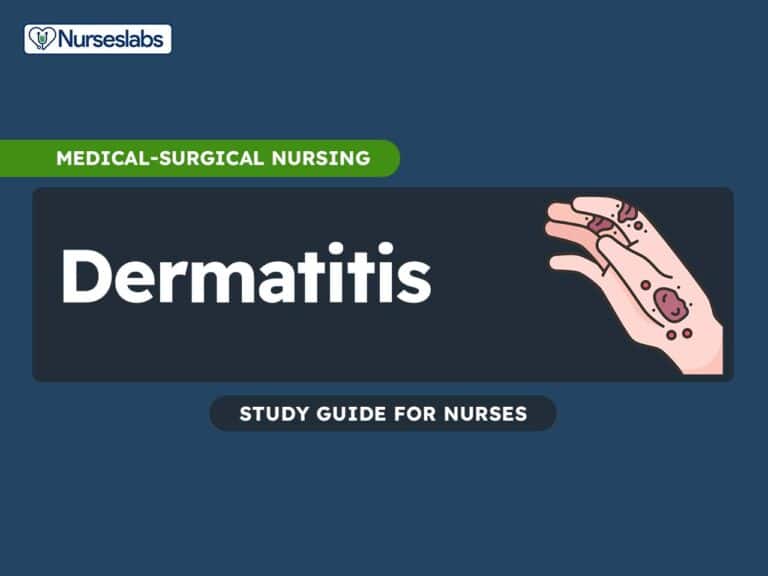
<?xml version="1.0" encoding="UTF-8"?> <rss version="2.0" xmlns:content="http://purl.org/rss/1.0/modules/content/" xmlns:wfw="http://wellformedweb.org/CommentAPI/" xmlns:dc="http://purl.org/dc/elements/1.1/" xmlns:atom="http://www.w3.org/2005/Atom" xmlns:sy="http://purl.org/rss/1.0/modules/syndication/" xmlns:slash="http://purl.org/rss/1.0/modules/slash/" ><channel><title>Nurseslabs &#187; impaired skin integrity</title> <atom:link href="http://nurseslabs.com/tag/impaired-skin-integrity/feed/" rel="self" type="application/rss+xml" /><link>http://nurseslabs.com</link> <description></description> <lastBuildDate>Mon, 06 Feb 2012 07:07:27 +0000</lastBuildDate> <language>en</language> <sy:updatePeriod>hourly</sy:updatePeriod> <sy:updateFrequency>1</sy:updateFrequency> <generator>http://wordpress.org/?v=3.3.1</generator> <xhtml:meta xmlns:xhtml="http://www.w3.org/1999/xhtml" name="robots" content="noindex" /> <item><title>4 Dermatitis Nursing Care Plans</title><link>http://nurseslabs.com/dermatitis-nursing-care-plans/</link> <comments>http://nurseslabs.com/dermatitis-nursing-care-plans/#comments</comments> <pubDate>Tue, 24 Jan 2012 17:32:48 +0000</pubDate> <dc:creator>NursesLabs</dc:creator> <category><![CDATA[Nursing Care Plans]]></category> <category><![CDATA[disturbed body image]]></category> <category><![CDATA[impaired skin integrity]]></category> <category><![CDATA[risk for infection]]></category><guid isPermaLink="false">http://nurseslabs.com/?p=560</guid> <description><![CDATA[<p>Dermatitis is a general term that describes an inflammation of the skin. View our Dermatitis Nursing Care Plan (NCP).</p><p><a href="http://nurseslabs.com/dermatitis-nursing-care-plans/">4 Dermatitis Nursing Care Plans</a> Original source at: <a href="http://nurseslabs.com">Nurseslabs</a></p>]]></description> <content:encoded><![CDATA[<p style="text-align: justify;"><a href="http://cdn.nurseslabs.com/wp-content/uploads/2010/04/Dermatitis.jpg"><img class="alignright size-full wp-image-1606" style="margin: 5px;" title="Dermatitis" src="http://cdn.nurseslabs.com/wp-content/uploads/2010/04/Dermatitis.jpg" alt="" width="250" height="250" /></a><strong>Dermatitis</strong> is a general term that describes an inflammation of the skin. There are different types of dermatitis, including seborrheic dermatitis and atopic dermatitis (eczema). Although the disorder can have many causes and occur in many forms, it usually involves swollen, reddened and itchy skin.</p><p style="text-align: justify;"><strong>Dermatitis</strong> is a common condition that usually isn&#8217;t life-threatening or contagious. But, it can make you feel uncomfortable and self-conscious. A combination of self-care steps and medications can help you treat dermatitis.</p><p style="text-align: justify;"></p><h2>1. Impaired Skin Integrity</h2><table border="1" cellspacing="0" cellpadding="0"><tbody><tr><td valign="top" width="199">Common Related Factor</td><td valign="top" width="276">Defining Characteristics</td></tr><tr><td valign="top" width="199">Contact with irritants or allergens</td><td valign="top" width="276"><ul><li>Inflammation</li><li>Dry, flaky skin</li><li>Erosions, excoriations, fissures</li><li>Pruritus, pain, blisters</li></ul></td></tr><tr><td valign="top" width="199">Common Expected Outcome Patient maintains optimal skin integrity within limits of the disease, as evidenced by intact skin.</td><td valign="top" width="276"><strong>NOC Outcomes</strong>Knowledge: Treatment Regimen; Tissue Integrity: Skin and Mucous Membranes<strong>NIC Interventions</strong> Skin Care: Topical Treatments; Skin Surveillance; Teaching: Procedure/Treatment</td></tr></tbody></table><h3><strong>Ongoing Assessment</strong></h3><table border="1" cellspacing="0" cellpadding="0"><tbody><tr><td valign="top" width="295"><strong>Actions/Interventions</strong></td><td valign="top" width="295"><strong>Rationale</strong></td></tr><tr><td valign="top" width="295">Assess skin, noting color, moisture, texture, temperature; note erythema, edema, tenderness.</td><td valign="top" width="295">Specific types of dermatitis may have characteristic patterns of skin changes and lesions.</td></tr><tr><td valign="top" width="295">Assess the skin systematically. Look for areas of irritant and allergic contact.</td><td valign="top" width="295">Flexural areas (elbows, neck, posterior knees) are common areas affected in atopic dermatitis.</td></tr><tr><td valign="top" width="295">Assess skin for lesions. Note presence of excoriations, erosions, fissures, or thickening.</td><td valign="top" width="295">Open skin lesions increase the patient’s risk for infection. Thickening occurs in response to chronic scratching (lichenification).</td></tr><tr><td valign="top" width="295">Identify aggravating factors. Inquire about recent changes in use of products such as soaps, laundry products, cosmetics, wool or synthetic fibers, cleaning solvents, and so forth.</td><td valign="top" width="295">Patients may develop dermatitis in response to changes in their environment. Extremes of temperature, emotional stress, and fatigue may contribute to dermatitis.</td></tr><tr><td valign="top" width="295">Identify signs of itching and scratching.</td><td valign="top" width="295">The patient who scratches the skin to relieve intense itching may cause open skin lesions with an increased risk for infection. Characteristic patterns associated with scratching include reddened papules that run together and become confluent, widespread erythema, and scaling or lichenification</td></tr><tr><td valign="top" width="295">Identify any scarring that may have occurred.</td><td valign="top" width="295">Long-term scarring may result in body image disturbances.</td></tr></tbody></table><h3><strong>Therapeutic Actions</strong></h3><table border="1" cellspacing="0" cellpadding="0"><tbody><tr><td valign="top" width="295"><strong>Actions/Interventions</strong></td><td valign="top" width="295"><strong>Rationale</strong></td></tr><tr><td valign="top" width="295">Encourage the patient to adopt skin care routines to decrease skin irritation:</td><td valign="top" width="295">One of the first steps in the management of dermatitis is promoting healthy skin and healing of skin lesions.</td></tr><tr><td valign="top" width="295"><ul><li>Bathe or shower using lukewarm water and mild soap or nonsoap cleansers.</li></ul></td><td valign="top" width="295">Long bathing or showering in hot water causes drying of the skin and can aggravate itching through vasodilation.</td></tr><tr><td valign="top" width="295"><ul><li>After bathing, allow the skin to air dry or gently pat the skin dry. Avoid rubbing or brisk drying.</li></ul></td><td valign="top" width="295">Rubbing the skin with a towel can irritate the skin and exacerbate the itch-scratch cycle.</td></tr><tr><td valign="top" width="295"><ul><li>Apply topical lubricants immediately after bathing.</li></ul></td><td valign="top" width="295">Lubrication with fragrance-free creams or ointments serves as a barrier to prevent further drying of the skin through evaporation. Moisturizing is the cornerstone of treatment. Over-the-counter moisturizing lotions include Eucerin, Lubriderm, and Nivea. Lotions are lighter and less emollient than creams. If more moisturizing is required than a lotion can provide, a cream is recommended. These include Keri cream, Cetaphil cream, Eucerin cream, and Neutrogena Norwegian formula. Ointments are the most emollient. Vaseline Pyre Petroleum Jelly or Aquaphor Natural Healing Ointment may be beneficial.</td></tr><tr><td valign="top" width="295">Apply topical steroid creams or ointments.</td><td valign="top" width="295">These drugs reduce inflammation and promote healing of the skin. The patient may begin using over-the-counter hydrocortisone preparations. If these are not effective, the physician may include prescription corticosteroids for topical use. Usual application is twice daily, thinly and sparingly. Do not use with an occlusive dressing, because this potentiates the action and systemic absorption of the steroid. Usual duration of use of topical steroids is up to 14 days in adults.</td></tr><tr><td valign="top" width="295">Apply topical immunomodulators (TIMs):</p><ul><li>Tacrolimus (Protopic)</li><li>Pimecrolimus (Elidel)</li></ul></td><td valign="top" width="295">Tacrolimus (Protopic) has recently been approved for the treatment of atopic dermatitis. TIMs alter the reactivity of cell-surface immunological responsiveness to relieve redness and itching. In 2005, the Food and Drug Administration advised a potential cancer risk with long-term use of pimecrolimus and tacrolimus based on animal studies.</td></tr><tr><td valign="top" width="295">Prepare the patient for phototherapy or photochemotherapy.</td><td valign="top" width="295">This treatment modality uses ultraviolet A or B light waves to promote healing of the skin. The addition of psoralen, which increases the skin’s sensitivity to light, may benefit patients who do not respond to phototherapy alone.</td></tr><tr><td valign="top" width="295">Encourage the patient to avoid aggravating factors.</td><td valign="top" width="295">Some change in lifestyle may be indicated to reduce triggers.</td></tr></tbody></table><p><a href="http://nurseslabs.com/dermatitis-nursing-care-plans/">4 Dermatitis Nursing Care Plans</a> Original source at: <a href="http://nurseslabs.com">Nurseslabs</a></p>]]></content:encoded> <wfw:commentRss>http://nurseslabs.com/dermatitis-nursing-care-plans/feed/</wfw:commentRss> <slash:comments>4</slash:comments> </item> <item><title>Rectal Adenocarcinoma Nursing Care Plans</title><link>http://nurseslabs.com/rectal-adenocarcinoma-nursing-care-plans/</link> <comments>http://nurseslabs.com/rectal-adenocarcinoma-nursing-care-plans/#comments</comments> <pubDate>Sat, 12 Nov 2011 12:37:26 +0000</pubDate> <dc:creator>NursesLabs</dc:creator> <category><![CDATA[Nursing Care Plans]]></category> <category><![CDATA[activity intolerance]]></category> <category><![CDATA[acute pain]]></category> <category><![CDATA[cancer]]></category> <category><![CDATA[constipation]]></category> <category><![CDATA[impaired skin integrity]]></category> <category><![CDATA[self-care deficit]]></category><guid isPermaLink="false">http://nurseslabs.com/?p=334</guid> <description><![CDATA[<p>Adenocarcinoma of the rectum arises as an intramucosal epithelial lesion, usually in an adenomatous polyp or gland. As cancers grow, they invade the muscularis mucosa, lymphatic structures, and vascular structures and involve regional lymph nodes, adjacent structures, and distant sites, especially the liver. Nursing goal for a patient with Rectal CA can be towards managing [...]</p><p><a href="http://nurseslabs.com/rectal-adenocarcinoma-nursing-care-plans/">Rectal Adenocarcinoma Nursing Care Plans</a> Original source at: <a href="http://nurseslabs.com">Nurseslabs</a></p>]]></description> <content:encoded><![CDATA[<p style="text-align: justify;">Adenocarcinoma of the rectum arises as an intramucosal epithelial lesion, usually in an adenomatous polyp or gland. As cancers grow, they invade the muscularis mucosa, lymphatic structures, and vascular structures and involve regional lymph nodes, adjacent structures, and distant sites, especially the liver.<span id="more-334"></span></p><p>Nursing goal for a patient with Rectal CA can be towards managing pain, managing symptoms, and patient education.</p><p><span style="line-height: 35px; font-size: 35px; letter-spacing: -1px;">Acute Pain</span></p><p>The patient has colorectal cancer and one of its symptoms is abdominal pain. The pain is a subjective unpleasant sensation resulting from stimulation of sensory nerve endings by injury, or other harmful factors. Pain is activated when a pt’s pain threshold is reached. Pain threshold is the point at which a stimulus activates pain receptors to produce a feeling of pain. Pain usually accompanies inflammation. It results from the synthesis of prostaglandins, which are hormones produced during the inflammatory process.</p><p>[ipaper id=27051342]</p><p><span style="line-height: 35px; font-size: 35px; letter-spacing: -1px;">Constipation</span></p><p>Due to decrease physical activity of patient, the movement of feces through the large intestine is slow, thus, the patient manifest difficulty or decreased frequency in defecation. And also there is a presence of blockage in the intestines forming bulk and therefore the stool cannot pass through. (Ed notes: also there is painful and straining-like passage of stool)</p><p>[ipaper id=27051346]</p><h1>Impaired Bed Mobility</h1><p>Abdominal cramping because of colorectal cancer there is a blockage of stool and formation of masse It starts from the synthesis of prostaglandins, which are hormones produced during the inflammatory process. The pain is triggered when the patient is moving so the response of the patient  he/she will not move to prevent initiation of pain.</p><p>[ipaper id=27051349]</p><h1>Activity Intolerance</h1><p>Activity intolerance is brought about by the weakness. Weakness is caused by cancer, cancer cells get the nutrients that normal cell needs. In this situation normal cell lack nutrients so they cannot perform their functions. There will energy that the body can use so instead of doing daily activities the patient will just take rest.</p><p>[ipaper id=27051339]</p><h1>Self-Care Deficit</h1><p>Restriction on the physical mobility of the client has resulted to a decreased ability for selfcare.  Specifically for this client, he has been unable to perform activities like bathing (and other measures of grooming), dressing up and attend to toileting needs by herself, thus, there is selfcare deficit. Weakness that is brought by cancer normal cells are lacking in nutrients. That the body needs in order to perform activities of daily living.</p><p>[ipaper id=27051358]</p><h1>Knowledge Deficit</h1><p>They cannot understand diagnostic procedures that’s why doctors and nurses must explain medical procedures to the patient level of understanding. And also they lack knowledge about the surgery. The affected colon must be remove as what the doctor decides.</p><p>[ipaper id=27051352]</p><h1>Risk for Impaired Skin Integrity</h1><p>Prolonged physical immobilization may cause pressure ulcers. Pressure ulcers may be caused by inadequate blood supply and as a result of  reperfusion injury when blood reenters tissue. A simple example of a mild pressure sore may be experienced by healthy individuals while sitting in the same position for extended periods of time: the dull ache experienced is indicative of impeded blood flow to affected areas</p><p>[ipaper id=27051354]</p><h1>Conclusion</h1><p>You guys know what&#8217;s written here right? Subscribe and comment! <a href="http://cdn.nurseslabs.com/wp-content/uploads/2010/02/0021.gif"><img class="size-full wp-image-335 alignleft" title="0021" src="http://cdn.nurseslabs.com/wp-content/uploads/2010/02/0021.gif" alt="" width="50" height="50" /></a></p><p><strong>Source: </strong></p><ul><li><a href="http://emedicine.medscape.com/article/373324-overview">eMedicine: Rectal Adenocarcinoma</a></li></ul><p><a href="http://nurseslabs.com/rectal-adenocarcinoma-nursing-care-plans/">Rectal Adenocarcinoma Nursing Care Plans</a> Original source at: <a href="http://nurseslabs.com">Nurseslabs</a></p>]]></content:encoded> <wfw:commentRss>http://nurseslabs.com/rectal-adenocarcinoma-nursing-care-plans/feed/</wfw:commentRss> <slash:comments>2</slash:comments> </item> <item><title>8 TAHBSO Nursing Care Plans</title><link>http://nurseslabs.com/tahbso-nursing-care-plans/</link> <comments>http://nurseslabs.com/tahbso-nursing-care-plans/#comments</comments> <pubDate>Mon, 31 Oct 2011 06:17:08 +0000</pubDate> <dc:creator>NursesLabs</dc:creator> <category><![CDATA[Nursing Care Plans]]></category> <category><![CDATA[acute pain]]></category> <category><![CDATA[fatigue]]></category> <category><![CDATA[hyperthermia]]></category> <category><![CDATA[impaired skin integrity]]></category> <category><![CDATA[risk for infection]]></category><guid isPermaLink="false">http://nurseslabs.com/?p=397</guid> <description><![CDATA[<p>Total abdominal hysterectomy bilateral salpingo oophorectomy (TAHBSO) is the removal of entire uterus, ovaries, fallopian tubes and cervix. View the Nursing Care Plans for TAHBSO</p><p><a href="http://nurseslabs.com/tahbso-nursing-care-plans/">8 TAHBSO Nursing Care Plans</a> Original source at: <a href="http://nurseslabs.com">Nurseslabs</a></p>]]></description> <content:encoded><![CDATA[<p style="text-align: justify;"><a href="http://cdn.nurseslabs.com/wp-content/uploads/2010/03/TAHBSO.jpg"><img class="alignright size-full wp-image-1585" style="margin: 8px;" title="TAHBSO" src="http://cdn.nurseslabs.com/wp-content/uploads/2010/03/TAHBSO.jpg" alt="TAHBSO" width="250" height="250" /></a>Total abdominal hysterectomy bilateral salpingo oophorectomy (TAHBSO) is the removal of entire uterus, the ovaries, fallopian tubes and the cervix. TAHBSO is usually performed in the case of uterine and cervical cancer. This is the most common kind of hysterectomy. Removal of the ovaries eliminates the main source of the hormone estrogen, so menopause occurs immediately.</p><p style="text-align: justify;">View the <a title="TAHBSO Surgical Procedure and Perioperative Management" href="http://nurseslabs.com/tahbso-surgical-procedure-and-perioperative-management/">surgical procedure for TAHBSO</a></p><p><strong>Post-operative nursing care for patients who underwent TAHBSO would include:</strong></p><ol><li>Determines patient’s immediate response to surgical intervention.</li><li>Monitor patient’s physiologic status.</li><li>Assess patient’s pain level and administers appropriate pain relief measures.</li><li>Maintains patient’s safety(airway, circulation, prevention of injury)</li><li>Administer medication, fluid and blood component therapy, if prescribed.</li><li>Assess patient’s readiness for transfer to in hospital unit or for discharge home based on institutional policy.</li></ol><p>This post includes several nursing care plans for<strong> post-TAHBSO</strong> patients.</p><p></p><h2 style="text-align: justify;">1 Acute Pain</h2><p style="text-align: justify;">Due to surgical procedure done that needs a surgical incision there will be presence of trauma in the area that signals an actual tissue damage and inflammation, this damage will cause an inflammation of the nerves when the nerves are affected, there will be the presence of pain.</p><table border="1" cellspacing="0" cellpadding="0"><tbody><tr><td valign="top" width="76"><strong>Assessment</strong></td><td valign="top" width="69"><strong>Nursing Diagnosis</strong></td><td valign="top" width="123"><strong>Planning</strong></td><td valign="top" width="112"><strong>Nursing<br /> Interventions</strong></td><td valign="top" width="100"><strong>Rationale</strong></td><td valign="top" width="102"><strong>Evaluation</strong></td></tr><tr><td valign="top" width="76"><strong>Subjective: </strong>The patient may verbalized:“My incision is hurts”<strong>Objective: </strong></p><p>The patient manifested :</p><p>-irritability</p><p>-impaired physical mobility</p><p>-disturbed sleep pattern</p><p>-facial mask</p><p>-diaphoresis</p><p>-restlessness</p><p>-facial grimaces</td><td valign="top" width="69">Acute pain secondary to surgical operation</td><td valign="top" width="123"><strong>Short term:</strong>After 4 hours of nursing interventions, the patient’s pain scale will decrease 10/10 to 5/10<strong>Long term:</strong>After 1 day of nursing interventions, patient’s pain will diminish and perform activities like side movement and leg bending</td><td valign="top" width="112">Establish rapportEmphasize ordered dietMonitor vital signsProvide comfort measure<br /> Encourage deep breathingProvide safety measure</p><p>Develop communication</p><p>review procedures/expectations and tell client when treatment will hurt</p><p>Administer analgesics as indicated to maximal dosage as needed</td><td valign="top" width="100">To gain trustTo encourage patient not to eat untolerated foodTo obtain baseline dataTo satisfy the confinement of patientTo inhibit pain</p><p>To prevent from injury</p><p>To alter pain and diminish emotional stress</p><p>To reduce concern of unknown and associated muscle tension</p><p>To maintain acceptable level of pain.</td><td valign="top" width="102"><strong>Short term:</strong>The patient’s pain scale decreased 10/10 to 5/10<strong>Long term:</strong>The patient’s pain diminished and performed activities like side movements and leg bending</td></tr></tbody></table><p><a href="http://nurseslabs.com/tahbso-nursing-care-plans/">8 TAHBSO Nursing Care Plans</a> Original source at: <a href="http://nurseslabs.com">Nurseslabs</a></p>]]></content:encoded> <wfw:commentRss>http://nurseslabs.com/tahbso-nursing-care-plans/feed/</wfw:commentRss> <slash:comments>6</slash:comments> </item> </channel> </rss>
<!-- Performance optimized by W3 Total Cache. Learn more: http://www.w3-edge.com/wordpress-plugins/

Minified using disk: basic
Page Caching using disk: basic
Database Caching 41/66 queries in 1.912 seconds using disk: basic
Object Caching 2135/2170 objects using disk: basic
Content Delivery Network via cdn.nurseslabs.com

Served from: nurseslabs.com @ 2012-02-06 21:42:07 -->