

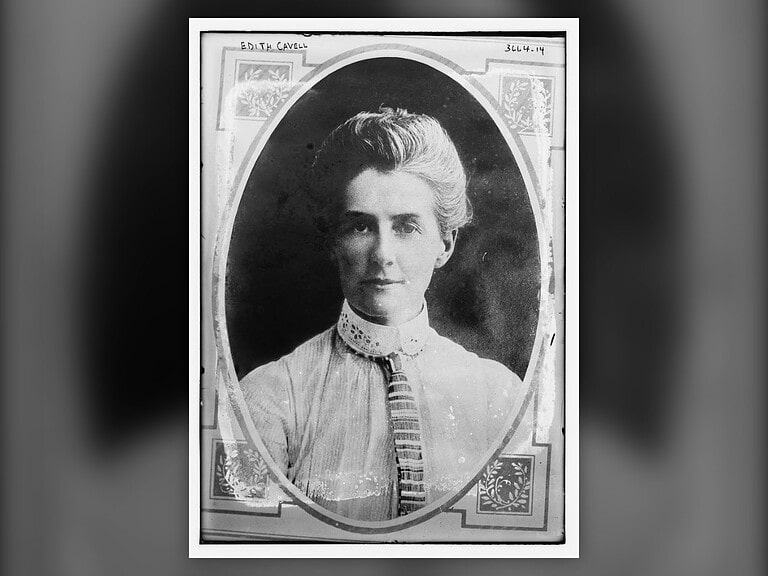
On 12 October 1915, a German firing squad in occupied Brussels executed a 49-year-old British nurse named Edith Cavell. Her crime was helping Allied soldiers escape. Her death caused international outrage, and she became one of the most famous nurses of the First World War.
Cavell was also a pioneer of nursing education in Belgium, and she cared for wounded soldiers from both sides of the war. This profile covers her life, her wartime work, and her legacy.
Edith Cavell at a Glance
- Born: 4 December 1865, Swardeston, Norfolk, England
- Died: 12 October 1915, Brussels, Belgium, at age 49
- Trained at: The London Hospital (from 1896)
- Known for: Nursing soldiers of both sides and helping about 200 Allied soldiers escape occupied Belgium
- Career: Matron of Belgium’s first school for trained nurses, Brussels (from 1907)
- Memorials: Statue near Trafalgar Square, London, and Mount Edith Cavell in Canada
Early Life and Nursing Training
Edith Cavell was the daughter of a vicar in the village of Swardeston in Norfolk. As a young woman she worked as a governess, including several years with a family in Brussels.
She turned to nursing after caring for her seriously ill father. She worked at Fountain Fever Hospital in London and in 1896 began training at the London Hospital. She later held senior nursing posts in London and Manchester.
Building Nursing in Belgium
In 1907 Belgian surgeon Antoine Depage invited Cavell to become matron of a new school for trained nurses in Brussels, the first of its kind in Belgium. At the time, most nursing in Belgium was done by religious sisters without formal training. Cavell set high standards, trained a generation of nurses, and in 1910 started a professional nursing journal.
Nursing in Occupied Brussels
When World War I began in 1914, Cavell was visiting her family in Norfolk. She returned to Brussels, which soon came under German occupation. Her school became a Red Cross hospital, and she and her nurses cared for wounded soldiers from both sides.
From late 1914, Cavell joined a network helping British, French, and Belgian soldiers trapped behind German lines. She hid soldiers at her school and helped about 200 of them reach the neutral Netherlands.
Arrest, Trial, and Execution
German authorities arrested Cavell in August 1915. She was tried by a German military court in October with other members of the network and charged with helping enemy soldiers reach a country at war with Germany. She was sentenced to death.
Diplomats from neutral countries, including the United States, appealed for mercy, but the sentence was carried out. On 12 October 1915 Cavell and Belgian architect Philippe Baucq were executed by firing squad. The night before, she told the chaplain who visited her that patriotism was not enough and that she must have no hatred or bitterness toward anyone.
Reaction and Legacy
Her execution caused outrage in Britain and in neutral countries, and her story was widely used in Allied wartime publicity. After the war her body was returned to England in 1919, honored at a service in Westminster Abbey, and reburied at Norwich Cathedral.
A memorial statue of Cavell stands near Trafalgar Square in London, and Mount Edith Cavell in Canada was named after her in 1916. In Belgium she is remembered as a founder of modern nursing education. Many nurses see her as an example of compassion and courage: she cared for every patient regardless of which side they fought on.
Explore More Nursing History
Cavell is one of several nurses whose courage in war shaped how the profession is remembered. Read about Vivian Bullwinkel, who survived a massacre of nurses in World War II, and see the bigger picture in our nursing history timeline.
Frequently Asked Questions
Quick answers to common questions about Edith Cavell.
Edith Cavell was a British nurse who ran a nursing school in Brussels. During World War I she cared for soldiers from both sides and helped about 200 Allied soldiers escape occupied Belgium. She was executed by a German firing squad in 1915.
She was convicted by a German military court of helping Allied soldiers escape from occupied Belgium to a country at war with Germany.
The night before her death, she told a chaplain that patriotism was not enough and that she must have no hatred or bitterness toward anyone.
She is commemorated by a statue near Trafalgar Square in London, Mount Edith Cavell in Canada, and her grave at Norwich Cathedral, and she is considered a founder of modern nursing education in Belgium.
References and Sources

Leave a Comment