

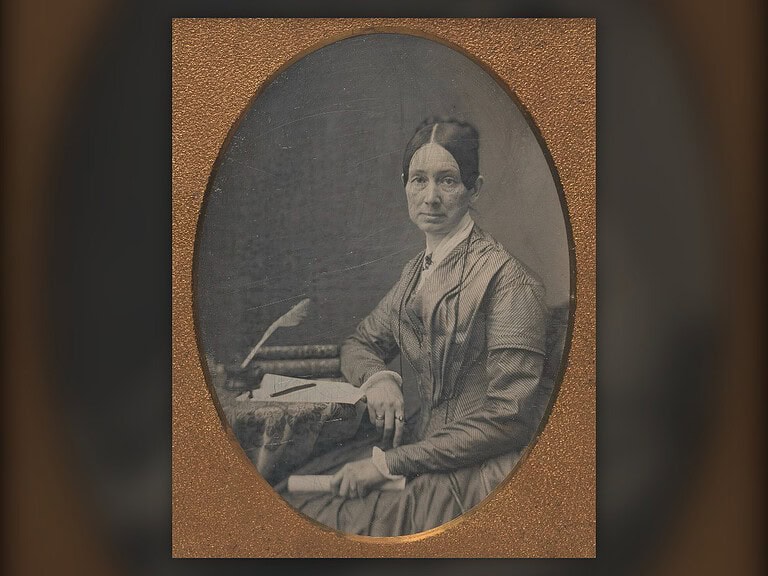
In the 1840s, people with mental illness in the United States were often locked in jails, poorhouses, and cages, sometimes chained and left without heat. A Boston schoolteacher named Dorothea Dix set out to change that, and she spent the rest of her life fighting for humane care.
During the Civil War, Dix also became the Union Army’s Superintendent of Army Nurses, recruiting thousands of women to care for wounded soldiers. This profile covers her reform work, her wartime role, and her legacy for psychiatric and military nursing.
Dorothea Dix at a Glance
- Born: 4 April 1802, Hampden, Maine
- Died: 17 July 1887, Trenton, New Jersey, at age 85
- Known for: Campaigning for humane care of people with mental illness
- Civil War role: Superintendent of Army Nurses for the Union, 1861 to 1865
- Impact: Credited with helping found or expand about 32 mental hospitals
- Honors: National Women’s Hall of Fame (1979) and a US postage stamp (1983)
Early Life and Teaching
Dorothea Lynde Dix had a difficult childhood and left home young. She began teaching at about 14 and later ran a school for girls in Boston from 1831 to 1836. She also wrote books for children. Dix was not a trained nurse; her work grew out of teaching, faith, and a strong sense of social duty.
Discovering the Conditions
In 1841 Dix began teaching a Sunday school class for women at the jail in East Cambridge, Massachusetts. There she found people with mental illness held alongside criminals in cold, filthy cells. She then spent about two years visiting jails, almshouses, and asylums across Massachusetts and recording what she saw.
In 1843 she presented a memorial to the Massachusetts legislature describing people kept in cages, closets, and stalls, often chained and beaten. Her report led the state to expand its mental hospital at Worcester.
A National Campaign
Dix took her campaign to state after state, including New Jersey, Pennsylvania, Illinois, and North Carolina, investigating conditions and lobbying lawmakers. She is credited with helping found or expand about 32 hospitals for people with mental illness.
She also asked Congress to set aside federal land to fund care for the mentally ill. The bill passed both houses in 1854, but President Franklin Pierce vetoed it, arguing that such care was the responsibility of the states.
Superintendent of Army Nurses
When the Civil War began, Dix volunteered her services. In June 1861 the Secretary of War appointed her Superintendent of Army Nurses, putting her in charge of recruiting women to nurse Union soldiers. She served without pay.
Dix set strict rules for her nurses. They had to be between 35 and 50 years old, plain in appearance, and dressed in simple clothing without jewelry. About 3,000 women served under her. She often clashed with army doctors and officials, and in 1863 much of her authority passed to the medical staff. She remained in the role until 1865.
Later Life and Legacy
After the war Dix returned to her advocacy work. In her final years she lived at the New Jersey State Hospital in Trenton, one of the hospitals she had helped create, and she died there in 1887.
Her work helped shift American attitudes toward mental illness, from punishment to treatment. Today’s psychiatric nursing grew in hospitals that reformers like Dix fought to build. See where she fits in our nursing history timeline, and read about Clara Barton, who also cared for soldiers in the Civil War.
Frequently Asked Questions
Quick answers to common questions about Dorothea Dix.
Dorothea Dix was an American teacher and reformer who campaigned for humane treatment of people with mental illness and served as the Union Army’s Superintendent of Army Nurses during the Civil War.
She was not a trained nurse. She was a teacher and reformer who led and recruited nurses as Superintendent of Army Nurses.
She documented terrible conditions in jails and almshouses and lobbied state legislatures to build or expand mental hospitals. She is credited with helping found or expand about 32 of them.
She required nurses to be between 35 and 50 years old, plain in appearance, and dressed simply without jewelry or cosmetics.
References and Sources

Leave a Comment